Car parks · Warehouses · Sports courts
Warehouse line marking guide
How to plan warehouse and factory floor marking that people actually follow: lanes, walkways, colours, zones and materials.
- Warehouse & factory safety lines
- Car parks to Australian Standards
- Night & weekend work
Start with traffic, not paint
Australia doesn't mandate a single colour code for warehouse floor marking. What WorkSafe Victoria does expect is that businesses control the risk of forklifts and other mobile plant, and separating pedestrians from forklifts is a key control. Line marking is how most sites show that separation: forklift lanes, pedestrian walkways, crossings, and exclusion zones around racking, docks and machinery, backed by physical barriers where the risk is high.
Before any lines go down, map how forklifts, trucks and people actually move through the site. Where do pedestrians need to go (amenities, offices, exits)? Where do forklifts turn, queue and reverse? The line marking then makes that plan visible.
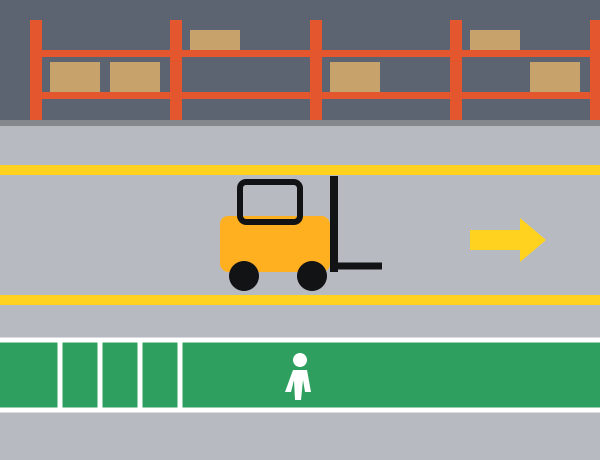
The core elements of a layout
| Element | Purpose | Common approach |
|---|---|---|
| Forklift lanes | Keep mobile plant on predictable routes | Solid lane edges, arrows for one-way systems |
| Pedestrian walkways | Give people a separate, protected route | Contrasting colour or hatching, barriers where risk is high |
| Crossings | Show where people cross forklift routes | Zebra-style hatching, stop lines for forklifts |
| Exclusion zones | Keep people and stock clear of hazards | Hatched areas at racking ends, docks, chargers |
| Storage and bays | Stop stock creeping into aisles | Corner marks or bay outlines with location codes |
| Clearance zones | Keep fire equipment and exits clear | Hatched boxes in front of hydrants, extinguishers, exits |
Colours: pick a system and stick to it
There's no single mandatory colour code for Australian warehouse floors. Common conventions many sites use:
- Yellow for forklift lanes and general traffic
- Green or white hatching for pedestrian walkways
- Red for fire equipment clearance and no-go areas
- Black and yellow hatching for hazard and exclusion zones
Whatever you choose, document it, include it in inductions and apply it consistently across every building on the site.
Lane and walkway widths
Forklift aisles need to suit the forklift, the load and whether two-way traffic is allowed, which is why widths come from the forklift supplier and your traffic management plan rather than a single number. Walkways need to be wide enough for people to walk without stepping into a lane, and wider where people carry things or pass each other. Your line marking contractor sets out to the widths your plan specifies.
Materials compared
| Material | Best for | Trade-off |
|---|---|---|
| Paint | Low traffic, temporary layouts, tight budgets | Wears quickly under forklifts |
| Epoxy | Busy forklift areas on sealed concrete | Higher cost, needs good preparation and cure time |
| Floor tape | Layouts that change often | Lifts under heavy wheels and turning |
| Thermoplastic | External yards and hardstands | Specialist equipment, higher cost |
Keeping lines effective
- Inspect lines as part of regular safety walks and re-mark high-wear areas before they fade out.
- Update lines whenever racking, docks or processes move. Old lines that no longer match the layout are worse than none, so remove them properly (see line removal).
- Pair lines with signs, mirrors, speed limits and physical barriers where the risk is high.
Ready to quote? See warehouse line marking or use the form.
A simple planning checklist
- Get a current floor plan and mark racking, docks, doors, amenities and exits.
- Draw forklift routes, then pedestrian routes, and circle every place they cross.
- Decide your colour system and write it down.
- Choose materials by area: epoxy for busy lanes, paint or tape for low-traffic or temporary zones.
- Agree timing with the contractor: overnight, weekends, staged sections or a shutdown.
- Update your induction and signage so the new layout is explained, not just painted.
Common questions
What are the standard colours for warehouse line marking in Australia?
There isn't one mandatory code. Yellow for traffic lanes, green or hatched walkways, red for fire equipment clearance and black-and-yellow hatching for hazards are common conventions.
How wide should a pedestrian walkway be in a warehouse?
Wide enough for people to walk, pass and carry items without stepping into a forklift lane. Your traffic management plan should set the width for your site.
Do warehouse walkways need barriers as well as lines?
Where forklifts and people are close together or traffic is heavy, physical barriers give better protection than paint alone. Lines work best as part of a wider traffic management plan.
How often should warehouse lines be re-marked?
High-traffic areas often need touching up every year or two with paint. Epoxy lasts longer. Re-mark whenever lines fade or the layout changes.
Keep reading
Car park faded? Warehouse lanes worn?
Tell us the site, the job and the timing. A Melbourne line marking contractor comes back with a quote.