Car parks · Warehouses · Sports courts
Thermoplastic line marking vs paint: which lasts longer?
Thermoplastic lasts several times longer than paint on a busy surface, but costs more to lay and needs specialist gear. Paint is cheaper and quicker, and makes sense where traffic is light or layouts change.
Last updated
- Warehouse & factory safety lines
- Car parks to Australian Standards
- Night & weekend work
The short answer
Thermoplastic line marking lasts much longer than paint. On a busy surface, paint often needs re-lining every one to three years, while thermoplastic is specified by VicRoads to last at least six years for profiled edge lines. Thermoplastic costs more upfront, so it pays off where traffic is heavy and the layout won't change.
That's the headline. The longer answer depends on what's driving over the lines, what surface they're on, and how long you expect the layout to stay the same. A truck hardstand in Laverton North and a 20-bay staff car park behind an office are very different jobs, and the right material for one is often the wrong material for the other.
Below is how each material actually goes down, how long it lasts in the real world, what drives the price, and the questions to ask a contractor before you sign off on a quote.
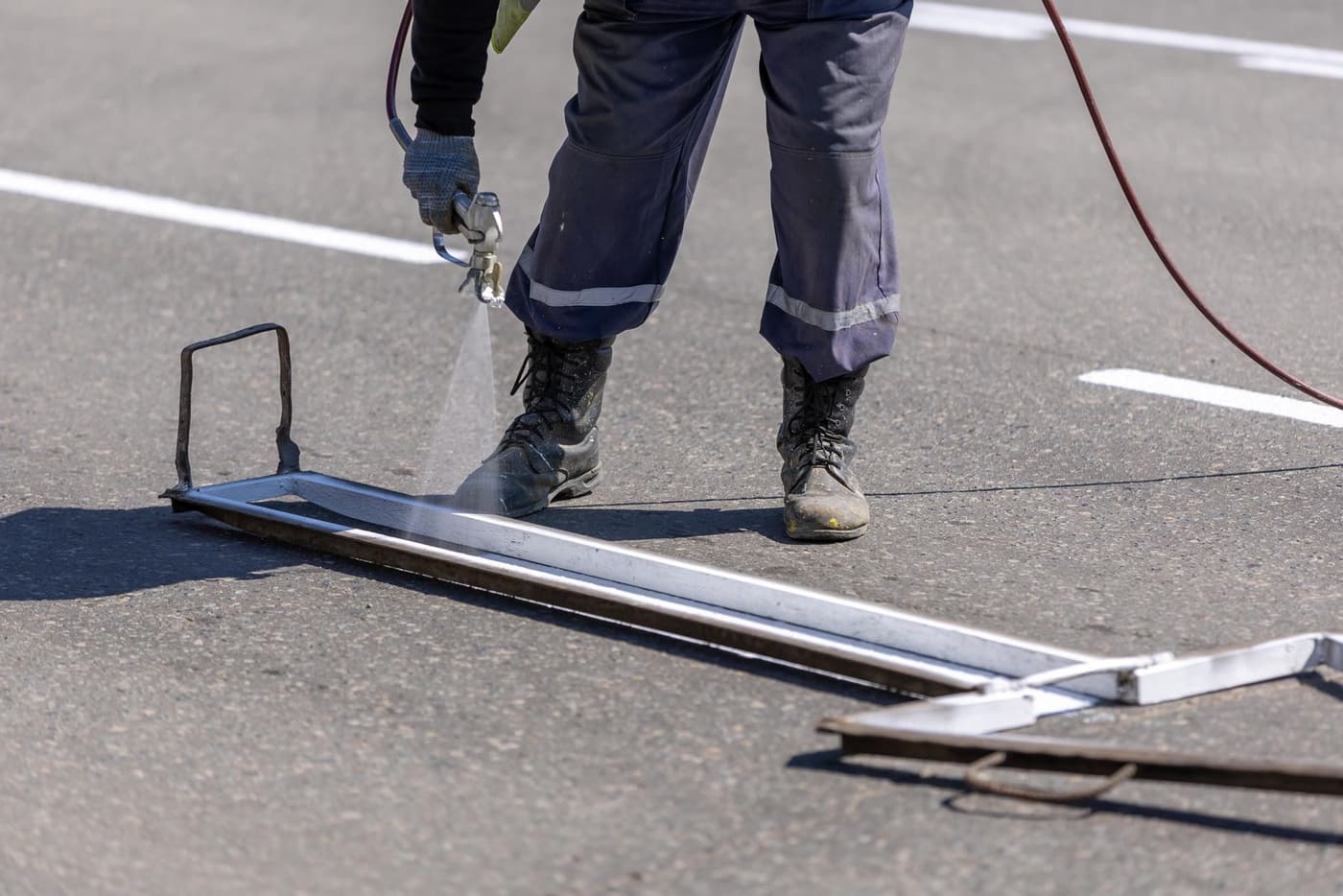
What is thermoplastic line marking?
Thermoplastic is a solid blend of resin, pigment, filler and glass beads. It arrives as blocks or granules, gets melted in a heated kettle on the truck, and is laid hot onto the pavement, either extruded or sprayed. As it cools, which takes minutes rather than hours, it sets hard and bonds to the surface. More glass beads are dropped onto it while it's still molten so the line reflects headlights at night.
That's why contractors and road authorities often call it thermoplastic road marking: it was developed for roads, where traffic never stops and re-marking means lane closures.
Because it goes down as a thick layer rather than a thin film, it has a lot more material to wear through before the line disappears. That's where the extra life comes from. It can also be laid as a raised, ribbed profile, which you'll know from highway edge lines that rumble when a tyre crosses them.
There's also preformed thermoplastic: symbols, arrows and lettering supplied as pre-cut sheets that are positioned on the surface and heated with a torch until they fuse in. These are common for accessible parking symbols, bicycle logos and pedestrian crossing markings where crisp shapes matter.
In Victoria, thermoplastic used on VicRoads contracts must comply with AS 4049.2, the Australian Standard for thermoplastic road marking materials. Private car parks don't have to follow VicRoads specifications, but a contractor who works to them is a good sign.
What kind of paint is used for line marking?
Line marking paint is a purpose-made coating, not house paint. There are two main types used outdoors in Australia:
- Water-borne paint. The everyday choice for car parks and most road re-marking. Lower odour, easier clean-up and quick to apply. The relevant standard is AS/NZS 4049.3.
- Solvent-borne paint, such as chlorinated rubber. Tolerates cooler, damper conditions a bit better. Covered by AS 4049.1. VicRoads limits where it can be substituted for water-borne paint.
Indoors, on warehouse and factory concrete, the usual choices are epoxy or polyurethane floor paints rather than road marking paint, because they resist forklift tyres, chemicals and scrubbing machines. That's a different comparison, covered on the warehouse line marking page.
Outdoor paint goes down thin. The VicRoads Section 722 specification for pavement markings calls for a minimum dry film thickness of 0.3 mm for most painted lines, with glass beads to AS/NZS 2009 dropped onto the wet paint for night visibility. Thin, quick and cheap is the whole point of paint, and it's also why it wears out faster.
How long does thermoplastic line marking last compared with paint?
Nobody can promise a fixed number of years, because the wear comes from tyres, and every site has a different mix of traffic. What you can compare is how each material behaves under the same conditions.
| Factor | Water-borne paint | Thermoplastic |
|---|---|---|
| Typical life in a busy car park or yard | Often one to three years before it looks tired | Several years. VicRoads requires at least six years for thermoplastic profiled edge lining |
| Thickness | Thin film, about 0.3 mm dry on VicRoads work | Much thicker, laid hot as a solid layer |
| Night reflectivity | Good when new, fades as beads wear off | Beads mixed through and dropped on top, so reflectivity holds up longer |
| Ready for traffic | Once dry, depends on temperature and humidity | Minutes, as soon as it cools |
| Upfront cost | Lowest | Higher, needs a heated kettle and trained operator |
| Changing the layout later | Easy to black out or grind off | Harder and slower to remove |
| Best on | Car parks with light to moderate traffic, sites that change often | Heavy truck and forklift routes, crossings, arrows, high-wear turning areas |
The places lines die first are always the same: turning circles, the entry and exit lanes, and anywhere a truck or forklift swings its wheels while stationary. Scuffing tyres grind paint off in a season. On many sites the smart move is to use both: thermoplastic where the wear concentrates and paint for the bays and long straight lines that barely get driven on.
Does thermoplastic cost more than painted line marking?
Yes, upfront. The material costs more, the kettle truck and operator cost more, and there's more set-up for a small job. Painted car park re-lining in Melbourne typically runs about $8 to $20 per bay, with a minimum charge of roughly $450 to $800 for small jobs, excluding GST. Thermoplastic isn't priced on a standard per-bay rate. Contractors quote it per site, per lineal metre or per symbol, depending on the mix of work.
The fairer way to compare is cost per year of visible line. If paint needs re-lining every year at your busiest crossing and thermoplastic lasts several, thermoplastic can come out cheaper over time, and you also avoid repeat disruption, after-hours call-outs and coned-off bays. On a quiet staff car park where paint lasts three years anyway, the maths rarely favours thermoplastic.
When you ask for quotes, ask the contractor to price both options for the high-wear areas so you can compare like with like. The Melbourne line marking price guide has the full price ranges for every job type.
Where does thermoplastic make sense, and where is paint the better choice?
Thermoplastic usually earns its keep at
- Truck yards, loading docks and hardstands with constant heavy vehicle turning
- Pedestrian crossings, stop lines, give way lines and arrows in busy car parks
- Accessible bay symbols and other shapes that need to stay crisp, often as preformed thermoplastic
- Shopping centre and hospital car park entries where reflectivity at night matters
- Council-type roads, bike lanes and access roads within large estates
Paint is usually the better call for
- Standard parking bays that are driven over slowly and rarely scuffed
- Sites where the layout may change in the next couple of years, such as a leased warehouse
- Small jobs where the set-up cost of a kettle truck would swamp the job
- Temporary marking, events, or staged works
- Indoor concrete floors, where epoxy or polyurethane is the proper comparison, not thermoplastic
Melbourne's west and south-east show the split clearly. Large distribution centres in Laverton North and Truganina run B-doubles and forklifts across their external yards all day, and that's exactly where paint lines vanish fastest. In the industrial streets of Dandenong and Dandenong South, many sites have a heavy-use yard out the back and a modest customer car park out the front, which is a classic case for thermoplastic in the yard and paint in the car park.
Does the surface affect which material you should use?
It matters as much as the traffic does.
- Asphalt in good condition takes both materials well. Thermoplastic bonds strongly to asphalt.
- Concrete is trickier for thermoplastic. Contractors usually use a primer or sealer first so the hot material grips properly. Ask how they'll prepare it.
- Fresh asphalt can need time before marking. Contractors often lay temporary paint first and come back for the permanent material once the surface has settled. VicRoads' own specification treats initial marking of new surfaces differently for this reason.
- Cracked, crumbling or oil-soaked surfaces will let any marking down. Lines peel with the surface. Fixing the pavement or cleaning heavily stained bays first is money well spent.
- Old lines underneath need to be dealt with. Laying fresh material over flaking paint traps the failure underneath. Where the layout changes, old lines should be removed rather than painted over in black.
Weather is the other variable. Both materials need a clean, dry surface. Melbourne's cold, damp winter nights, which is when a lot of car park work is booked to avoid trading hours, can slow paint drying and limit the working window, so expect a contractor to watch the forecast and reschedule if it's wet.
Which Australian Standards apply to line marking materials and layouts?
Australian Standards are published by Standards Australia. Two separate sets of standards come into play, and it helps to know which is which:
- Materials. AS 4049.1 (solvent-borne paint), AS/NZS 4049.3 (water-borne paint), AS 4049.2 (thermoplastic) and AS/NZS 2009 for glass beads. VicRoads specifications also require paints to be approved under the Australian Paint Approval Scheme (APAS).
- Layouts. Off-street car parks are designed to AS/NZS 2890.1, and accessible parking to AS/NZS 2890.6. These control bay sizes, aisle widths and symbols, regardless of whether the lines are painted or thermoplastic.
Switching material doesn't change the layout rules. If a car park is being re-lined in thermoplastic, the contractor still needs to set it out to the layout standards, and any accessible bays still need the correct shared zone and symbol. The car park line marking page covers the layout side.
Who does thermoplastic line marking and road line marking in Melbourne?
Thermoplastic needs a kettle truck, a heated applicator and an operator who knows how to lay it at the right temperature and thickness, so not every line marking business offers it. Plenty of contractors who do car parks with paint subcontract thermoplastic, or don't do it at all. That's worth knowing before you ask for quotes, because a contractor who only owns a paint machine will naturally recommend paint.
The contractors who do both tend to work across private car parks, industrial estates and road line marking in Melbourne for councils, builders and developers. When you request quotes, say clearly which areas you want priced in thermoplastic and which in paint, roughly how many bays, arrows and lineal metres are involved, and whether the site has to stay open while the work is done. A photo of the worst-worn area helps a contractor judge it before the site visit.
Expect the contractor to visit or measure up before giving a fixed written quote. For a mixed job, ask for the thermoplastic and paint parts listed separately, so you can drop or add areas without starting again.
What should you ask a line marking contractor before choosing?
- Which areas on my site wear out fastest, and would you put thermoplastic there and paint elsewhere?
- Can you price both options for the high-wear areas so I can compare cost over time?
- What material and standard will you use, and is the paint APAS approved?
- How will you prepare the surface, and do old lines need removing first?
- Will you set the layout out to AS/NZS 2890.1 and 2890.6, or re-line the existing marks as they are?
- When can the work be done so the site keeps operating, and how long before traffic can go back on?
- What happens if the weather turns on the night?
Requesting quotes through this site is free. Your request goes to independent Melbourne line marking contractors, who inspect or measure the site, quote you directly and invoice you for the work.
Sources
Material standards, the 0.3 mm minimum paint film, glass bead requirements, APAS approval and the six-year minimum service life for thermoplastic profiled edge lining are from the VicRoads Section 722 specification for pavement markings (VicRoads, April 2008, as published by Wyndham City Council). Layout standards are AS/NZS 2890.1 and AS/NZS 2890.6 from Standards Australia. Prices are indicative Melbourne ranges from this site's price guide, excluding GST; contractors quote each site individually.
Common questions
How long does thermoplastic line marking last?
Usually several years, and much longer than paint on the same surface. VicRoads specifies at least six years of service life for thermoplastic profiled edge lining. Actual life depends on traffic, turning tyres, the surface and how well it was laid.
Is thermoplastic better than paint for car parks?
For high-wear spots like entries, crossings, arrows and turning areas, often yes. For standard bays with light traffic, paint is usually cheaper overall. Many car parks use thermoplastic where tyres scuff and paint for the bays.
Can thermoplastic be laid on concrete?
Yes, but concrete usually needs a primer or sealer first so the hot material bonds properly. Ask the contractor how they'll prepare the surface. Indoor warehouse floors are normally marked with epoxy or polyurethane instead.
How soon can you drive on thermoplastic line marking?
Within minutes. Thermoplastic sets as it cools, so traffic can usually return very quickly. Paint needs to dry first, which takes longer in cold or humid weather.
What Australian Standard covers thermoplastic road marking?
AS 4049.2 covers thermoplastic road marking materials. Paint is covered by AS 4049.1 for solvent-borne and AS/NZS 4049.3 for water-borne, and glass beads by AS/NZS 2009.
Is thermoplastic line marking hard to remove?
Harder than paint. Because it's thick and bonded hot, it usually has to be ground or blasted off, which takes longer and costs more. That's why paint suits layouts that are likely to change.
Can you paint over old thermoplastic lines?
It's not recommended for changing a layout. Painting black over old lines wears off and the old marks show through, which confuses drivers. Removing the old lines properly is the better approach.
Keep reading
Car park faded? Warehouse lanes worn?
Tell us the site, the job and the timing. A Melbourne line marking contractor comes back with a quote.